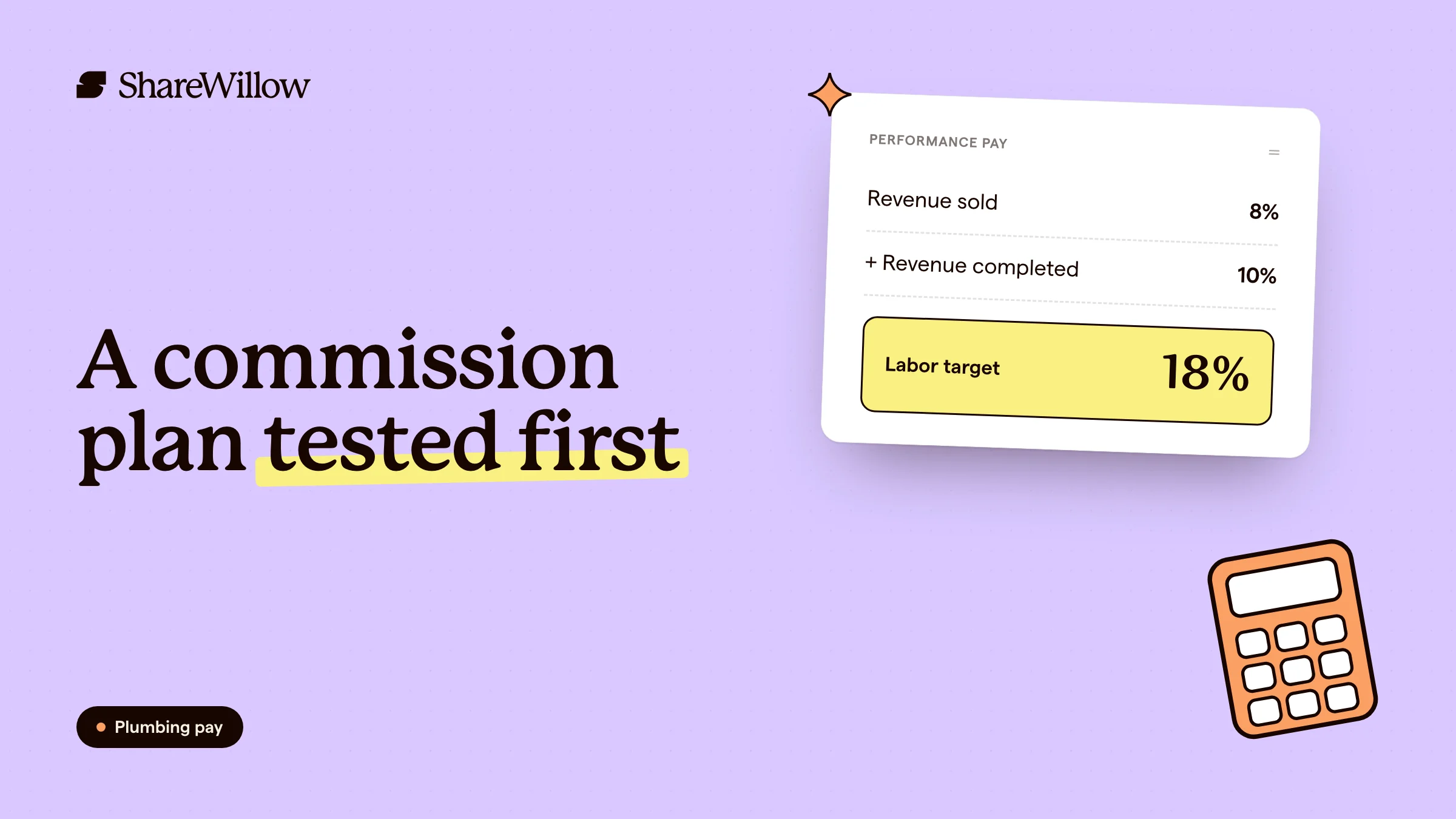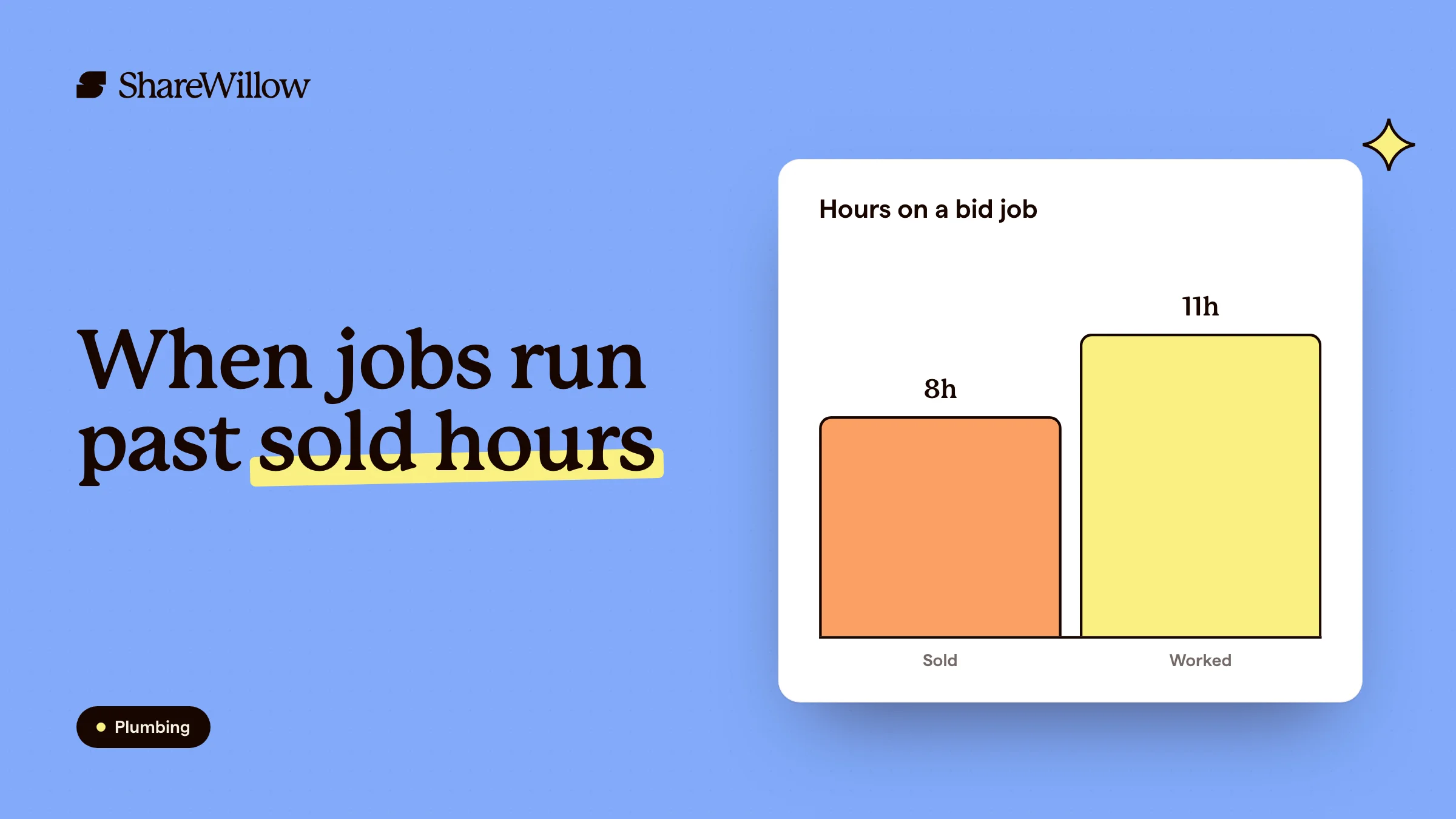
Technician efficiency bonus: a plumbing company is excluding any job sold with over 8 hours from the bonus when hours worked exceed hours sold.
A technician efficiency bonus has to answer one question: what happens when the job runs long?
Most owners who set up a technician efficiency bonus start from revenue. A technician finishes more work, the revenue number goes up, and the bonus follows. That holds up well on service calls. It breaks on the big jobs, where the price is fixed on the day you bid it and every extra hour comes out of your margin instead of the customer's pocket.
A plumbing company we work with ran into exactly this in November. The manager who runs the plan opened a review call with one question: how do we gauge efficiency? He had a technician who, in his words, had "burned up all the hours" on his last two jobs. One of those jobs had been bid for two days. On the morning of the call, the technician was on day four.
Because the bonus was built on job dollars, that job was still going to count. "I don't want to reward him for bad behavior," he said.
This post covers the rule the company added that day, the credit split that sits underneath it, and how the owner checks every bonus before payroll. One thing to be clear about up front: the rule is brand new. Technicians will not see the plan until about January 1, so there are no before-and-after results to report yet. What we can show is the design and the reasoning, which is the part most owners get stuck on.
The problem: two kinds of overrun, and only one was covered
The company does service work plus larger projects: repipes, sewer lines, water lines, and tunnel jobs. Those two kinds of work behave very differently when a technician takes longer than planned.
Service calls were already protected
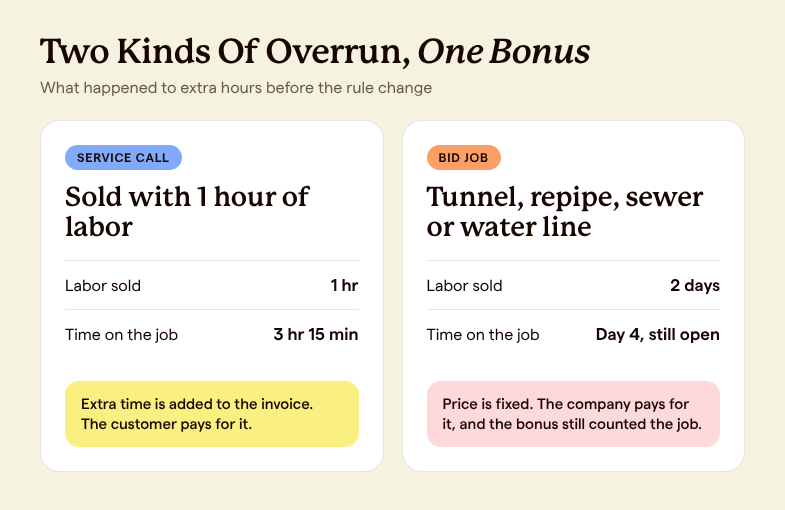
Most service tasks at this company are sold with one hour of labor. When a technician goes over, the office recalculates the invoice and a line is added for the extra time. On the call, the manager pulled up an example: a task sold with one hour that took 3 hours and 15 minutes on site, plus 12 minutes of drive time. The extra hours were billed.
So on service work, a slow job does not quietly eat margin. The customer pays for the time, and the revenue the technician is credited with reflects it.
Bid jobs were not
A bid job is priced once. The job in question was sold with 16 hours for the lead plumber and 8 hours for a helper. If the lead works four eight-hour days, that is 32 hours against 16 sold, with no extra line on the invoice to cover it. The price does not move. The labor cost does.
Meanwhile the bonus only looked at the dollars. A dollar of revenue from a job that finished early and a dollar from a job that ran double were worth the same to the technician. That is the gap the manager wanted closed.
The fix: on big jobs, finish on time or the job does not count
There were a few ways to handle this. One option was a weekly billable efficiency percentage, which compares working time with total hours on the clock. Another was revenue per labor hour, so a three-hour job done in four hours earns less than the same job done in two. Both are reasonable measures, and we wrote about the first one in a piece on a plumbing technician billable hours bonus.
The company chose something simpler, and stricter.
- The trigger is 8 sold hours. Any job sold with more than 8 hours of labor gets tested. In practice that means repipes, sewer lines, water lines, and tunnels, without anyone having to maintain a list of job types.
- The test is sold hours against hours worked. If the hours worked are at or under the hours sold, the job counts toward the bonus the normal way.
- If the job goes over, the whole job is excluded. It does not earn a reduced amount. It earns nothing. Technicians are credited on large jobs only when they finish on time or early.
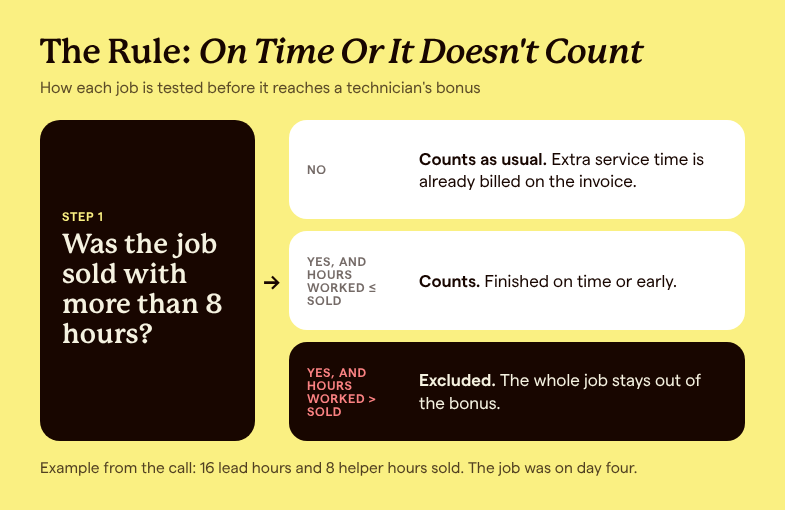
Under that rule, the four-day job from the call would not be eligible. The job that ran over simply does not go into the bonus.
Why per job and not per week
For short work, a weekly revenue number is a good efficiency measure on its own. A technician who moves through calls completes more jobs in a day, and the bonus rises with it. Long jobs are different. A plumber on a tunnel job is on that job all day, sometimes all week, so there is no volume to reward. The only useful question is whether that specific job met its plan.
Other companies have landed on a softer version of the same idea, paying for each hour a crew saves instead of using a pass or fail test. An outdoor living company we wrote about built a crew bonus plan that pays $50 for every hour saved. Either approach works. The pass or fail version is easier to explain on a job site, and it matches what this manager said he wanted: no reward for a job that ran over.
The split underneath: who gets credit for a job
An efficiency rule only matters if the credit behind it is right, and the second half of the call was about that. The owner had spotted a job where one technician showed 100% of the credit, even though a different technician had sold it.
The cause is a common one. Field service software usually assigns the full job to the primary technician unless someone goes in and types a split by hand. This company's plan does not rely on that field. It applies the same rule to every job:
- Start with the job price.
- Subtract material cost.
- Subtract the helper hours line on the invoice, whatever it totals, whether that is one hour or four.
- Split what is left 30% to the seller and 70% to the technicians who completed the work.
- If two technicians completed it, split their share 70/30 between the lead and the helper.
If no seller is named on the job, the full amount falls to the completing side. If only one technician completed it, that technician gets the whole completion share.
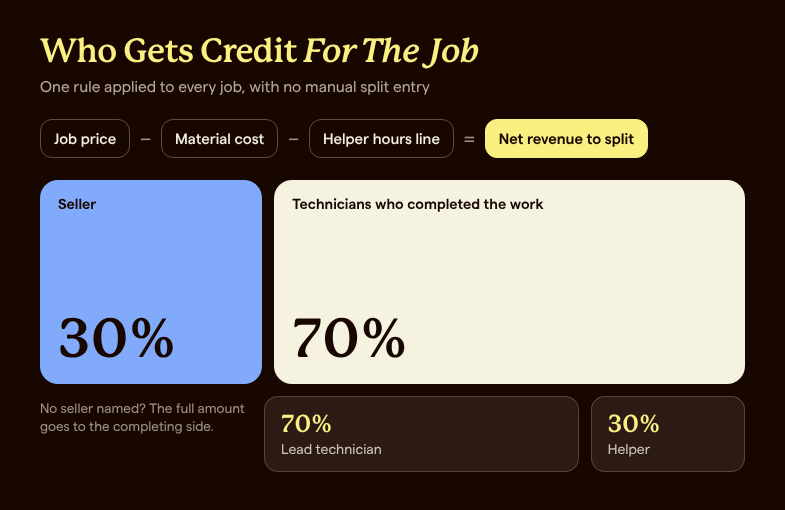
Here is how that plays out with made-up numbers, since the company did not share job totals on the call. Take a $10,000 repipe with $3,000 in materials and an $800 helper hours line. The amount to split is $6,200. The seller is credited with $1,860. The completing side gets $4,340, which divides into $3,038 for the lead and $1,302 for the helper. Those are credits toward each person's bonus calculation, not the payout itself.
Now add the new rule. If that repipe was sold with 24 hours and the crew logged 30, none of that $6,200 reaches the bonus. If they logged 22, all of it does.
The 30/70 direction was a recent change. An earlier version of this plan gave the seller the larger share, and the company flipped it so most of the credit now sits with the people who complete the work. If you are weighing the same choice, a different plumbing company's approach to a seller and completion split is a useful comparison.
Checking every bonus before payroll
The owner reviews bonuses before payroll runs on Thursday morning, and he wanted to see, in black and white, what makes up each technician's number. That request shaped two decisions.
First, the review happens at the line-item level. For any pay period, the office can select an employee and see each job line that fed the calculation, then download it as a spreadsheet to check against what they expect. The company also asked for a written recap, by technician, of the jobs counting toward the current period.
Second, technicians cannot see the plan yet. The company has it running in the background while the owner works out the kinks, and the target is to open it up to the team around January 1. That order matters. An efficiency rule that excludes jobs will get challenged the first week it costs someone money. It is much easier to defend when the split logic and the hours data have already been checked for several weeks.
Visibility is also what makes the rule work once it is live. A technician who can see, mid-job, that a repipe is about to pass its sold hours has a reason to push. A technician who finds out on payday does not. We track plans like this in ShareWillow so the job-level detail is there for both the owner and the team.
What to borrow if you run a plumbing company
You do not need this company's exact numbers. You need the same four decisions, written down.
- Separate the work that bills overruns from the work that does not. If your service tasks are recalculated when they run long, revenue already reflects the time. Bid work needs its own test.
- Pick a simple trigger. This company used 8 sold hours. A threshold on sold labor is easier to maintain than a list of job types, and it catches new kinds of large jobs automatically.
- Decide between pass or fail and a sliding scale. Pass or fail is blunt and clear. A sliding scale, such as an award per hour saved, keeps some incentive alive on a job that is already over. Our roundup of bonus structure examples shows how each type is usually built.
- Fix the hours before you launch. The rule depends on sold hours being realistic and worked hours being recorded against the right job. If your bids are routinely short, technicians will read the rule as a penalty for your estimating.
That last point is the honest limit of any efficiency plan. An overrun can come from a slow technician, a bad bid, or a surprise behind the wall. Run the comparison for a few months before it touches pay, and look at whether the same job types miss every time. That pattern points at the estimate, not the crew. If you are building this for a plumbing company, start there.
More real examples
The same question comes up with other companies. Here is how a few of them answered it, with their numbers.
How a Plumbing Company Found Its Techs Bill 4 Hours of an 8-Hour Day
A plumbing technician billable hours bonus needs clean data first. See how one company found techs bill 4 of 8 hours and set a 6 to 8 hour target.
The company is a plumbing business that switched from dynamic to static pricing. Its technicians sell and complete jobs, and a 1% to 3% revenue incentive is split between the seller and the techs on the job. On a review call, the owner and a ShareWillow specialist looked at the hours behind those jobs. The headline number was hard to ignore: technicians were billing about 4 hours in an 8-hour day. The goal is 6 to 8.
This post walks through what they found, how they are defining billable efficiency, and what any plumbing owner can borrow before launching an efficiency bonus of their own.
How One Company Measured a $675 Job at $236.84 Against a $285 Target
Revenue per billable hour: how an HVAC and refrigeration company measured a $675 job at $236.84 an hour against a $285 target and rebuilt its bonus.
That $48 gap was not showing up anywhere. The company already had a metric called billable efficiency in its technician pay plan, but it was measuring something different: the share of paid hours spent on billable work. A technician could look fine on that report while every one of their hours earned less than the business needs.
This post walks through how the company is redefining the metric, the rules it set for shared jobs and non-billable time, and the data cleanup it took to trust the result. The new calculation is still being validated against real jobs, so no payouts are tied to it yet. The definition work is the useful part, because it is where most efficiency bonuses go wrong.
FAQ
What is a technician efficiency bonus?
It is a bonus that rewards technicians for how well they use time, not only for how much revenue they produce. Common versions pay on billable hours as a share of total hours, on revenue per labor hour, or on finishing jobs within the hours that were sold.
Should a technician lose the whole bonus if one job runs over?
In this company's plan, only the job that ran over is excluded. Every other job in the period still counts. That keeps one bad job from wiping out a good week, while making sure the company is not paying a bonus on work that lost money.
How do you measure technician efficiency on large jobs?
Compare the labor hours sold on the job with the hours worked on it, including helper time. This company applies that test to any job sold with more than 8 hours. Shorter service work is measured through revenue, because extra time on those jobs is billed to the customer.
Related reading
- Plumbing Technician Billable Hours Bonus: How a Plumbing Company Found Its Techs Bill 4 Hours of an 8-Hour Day
- Crew Bonus Plan: How an Outdoor Living Company Is Paying $50 for Every Hour Its Crews Save
- Landscaping Crew Bonus Plan: Why a 31.83-Hour Savings Report Turned Into 54.25 Real Hours on a 50-Hour Bid
- How to Calculate Bonus Pay: A Step-by-Step Guide to Fair and Motivating Compensation
Conclusion
Bill overruns where you can, test bid jobs against sold hours where you cannot, and check the hours data before the rule touches anyone's pay.
See what performance pay would pay your techs.
On a free call, we'll show you what your techs would earn for the great work they already do.
Book a free call
Ryan Shank is the founder of ShareWillow. Before ShareWillow, he spent 15 years building software for the trades and founded PhoneWagon, which CallRail acquired.