Pool technician pay structure with separate route and service plans, lead credit without selling, and a recall bonus that protects a rate already under 2%.
A good pool technician pay structure has to answer an awkward question: how do you pay the person who cleans the pool and the person who fixes it with the same plan? A Florida pool service company with seven route technicians and three service and install technicians decided you do not. It signed up this month, and the first thing it asked for was two different plans, one for each crew, built before its busy season starts.
The company is not trying to fix a broken bonus. Its recall rate is already below 2%, and the owner wants to keep it there as the team grows. The plan is to reward the behavior that got them here, add a reason to find extra work, and make sure nobody's paycheck surprises the company. This one is still in setup, so there are no payouts to report. We would rather describe a plan honestly than invent a result for it.
The Problem: Route Work and Repair Work Are Different Jobs
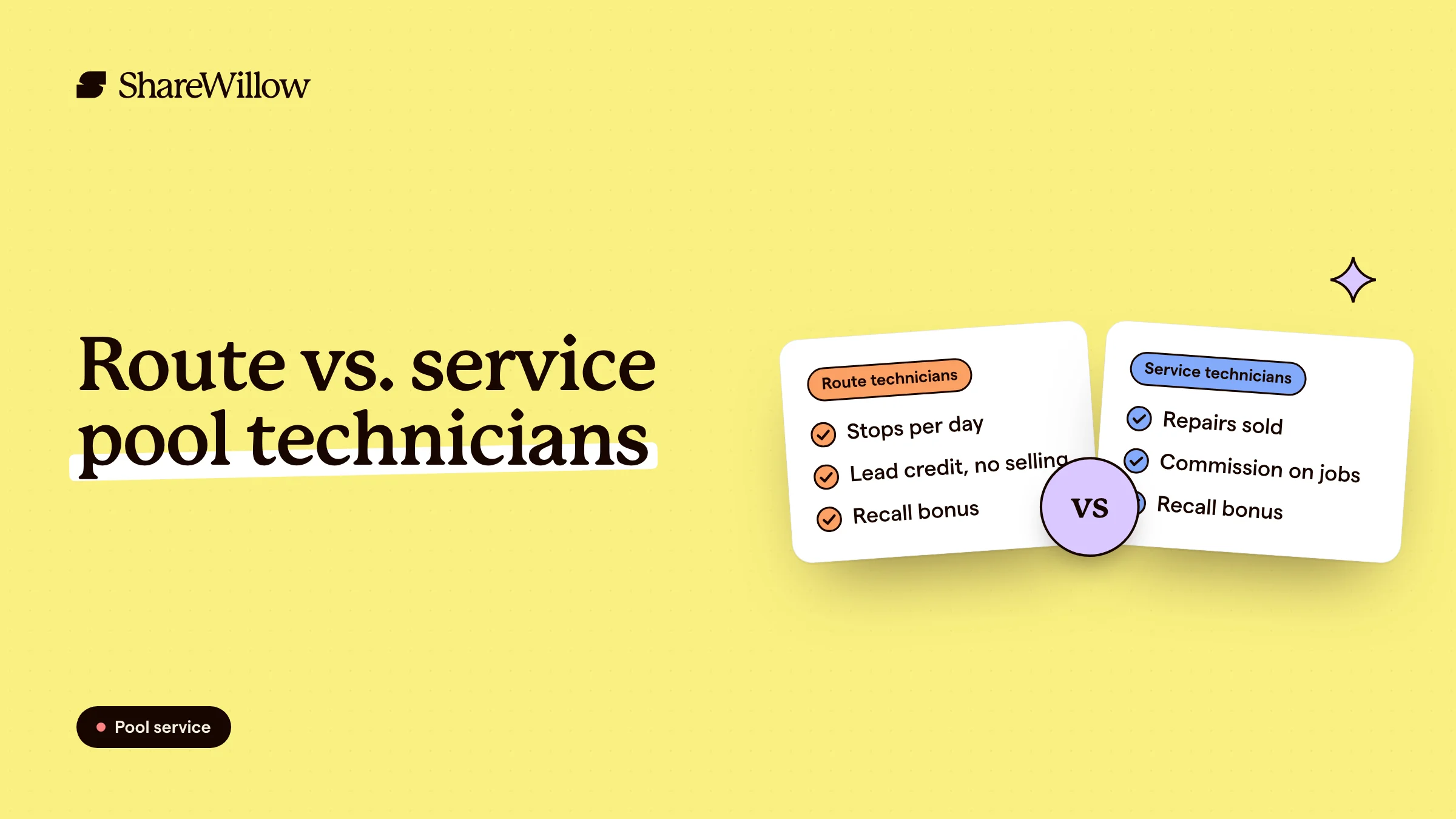
A route technician services a set of pools on a schedule. Their value is consistency: every step done, every visit on time, nothing skipped. A service technician diagnoses and repairs equipment, so their value shows up in revenue, completed repairs, and callbacks. Put both on one commission plan and one group wins by accident while the other group watches money go by.
Pool companies also pay in several different ways. Hourly base pay, a per-stop rate, and base pay plus a performance bonus are all common. Each has trade-offs. Per-stop pay rewards speed and can encourage rushing. Hourly pay is steady but says nothing about quality. The owner here wants to keep a base and layer incentives on top, so the plan adds to what technicians already earn instead of replacing it.
There is a quieter issue as well. Route tasks are easy to skip without anyone noticing, and customers may not see the omission for days. The owner already uses a separate photo app that date-stamps images to document work. Visible performance tracking inside the pay plan adds a second layer of accountability, and it works best when the numbers technicians see are the numbers they get paid on.
A Pool Technician Pay Structure With Two Plans
The route plan focuses on efficiency and on one extra behavior: spotting a need and handing it off. Route technicians are not expected to sell. The preferred move is to notice a worn part or a failing pump, tell the customer a service technician can look at it, and let the service side handle the repair. A small spiff or percentage rewards the route technician for generating that lead.
The mechanics work because lead credit can follow the person who started it. ServiceTitan's technician-generated lead data lets the route technician receive credit even when a different technician completes the work. Without that, the person who noticed the problem gets nothing and quietly stops mentioning problems. We saw the same pattern in an HVAC and plumbing company that found $52,000 in tech-sourced sales its report showed as zero.
The service plan tracks repair performance. Service technicians can also earn a share for finding additional work beyond the original call, such as a plumbing or filter need discovered during a repair visit. Both plans live in the same system, but leaderboards stay separated by plan, so a route technician is never ranked against a service technician's repair revenue.
Recall Pay: Deduct Per Callback or Pay a Bonus for a Low Rate
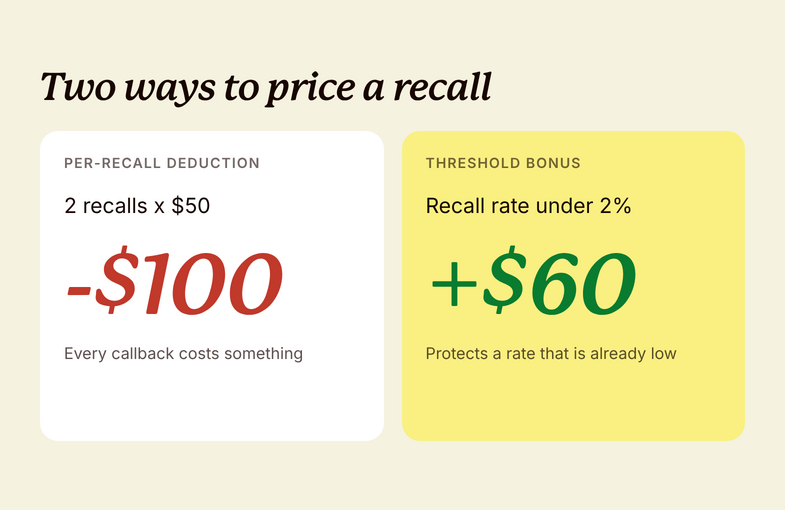
Quality is where this company's plan gets interesting. Two recall incentives were discussed. The first deducts a set amount for every recall, for example two recalls at $50 each, which takes $100 out of a technician's award pay. The second pays a bonus, such as $60, for keeping the recall rate below 2%.
The deduction is a stick. It punishes every callback, which makes sense for a company still trying to bring a high recall rate down. The bonus is a carrot. It protects a standard the company already meets, and it avoids the bad feeling of watching a good month shrink because of one unlucky return visit. Since this company's rate is already under 2%, the bonus fits the goal: preserve strong service as headcount grows.
Either approach only works if recalls are recorded accurately at the time the appointment is created. We compared both models in how an HVAC company tied the same bonus to a 3% quality bar and in a fixed $50 callback charge assigned back to the original install crew. The lesson from both is the same: pick the model that matches where your callback rate is today, then make every recall traceable to a specific job.
Forecast Before You Commit to a Percentage
The owner set a clear guardrail. Before any percentage is final, she wants to see a December forecast, and she named one scenario she will not accept: a $10,000 monthly payout. That is a smart place to draw the line, because a plan can look generous in a meeting and still outrun the business.
The forecast will use historical data, including the previous 12 months, and the plan will be adjusted based on what it shows. Rates are set after reviewing the company's labor rate, revenue, affordability, and prior performance, so technician earnings rise with revenue or efficiency rather than ahead of them. If you want a sense of how small the first real payouts can be, read about a pool company's first incentive plan and its single $208 payout.
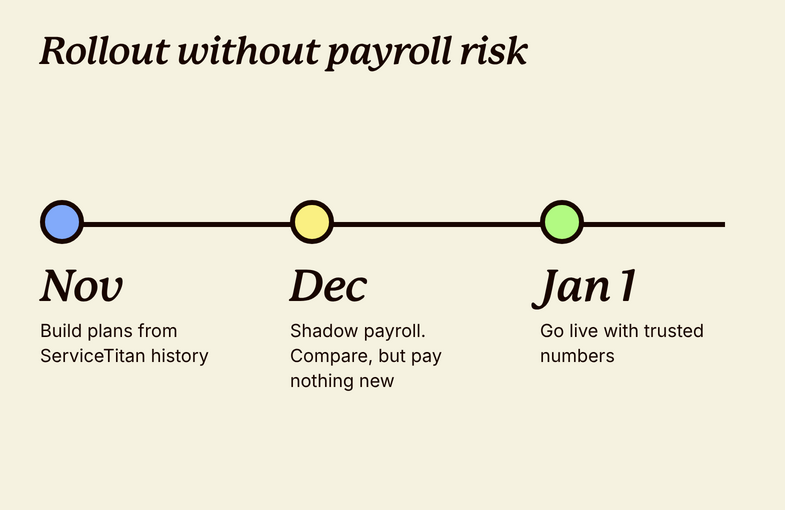
Shadow Payroll in December, Go Live on January 1
The rollout is deliberately slow. Plans get configured in November. December runs as shadow payroll: the system calculates what every technician would have earned, the company compares it with real payroll, and nobody is paid anything new. January 1 is the go-live date. The company is entering its busy season, so owner time is limited, and a phased launch avoids a chaotic first week over the holidays.
There is a second reason for the timing. The company expects a move to a new ServiceTitan tier to create some short-term friction, and it wants the incentive plan settled first. Data syncs from ServiceTitan three times a day, so technicians can open their own app logins to see incentive earnings, effective hourly rate, and upcoming and completed jobs without waiting for payday. Earlier posts on thresholds that paid nothing, like the month every pool technician missed the bonus, are the reason shadow payroll exists: you want to find that kind of problem while it costs nothing.
Text messages can reinforce the plan once it is live. Examples discussed included a reminder about completing more than 100 cleanings in a week, or keeping callbacks below 1% to 2%. For a broader look at how to design the incentive itself, our guide to bonus structure examples is a good companion.
The Result: A Pool Technician Pay Structure Built to Be Checked
There is no payout total yet, and that is the point of the phased launch. What exists is a plan with five pieces anyone can verify: separate route and service plans, lead credit for route technicians who do not sell, a recall incentive matched to a rate that is already under 2%, a 12-month forecast with a hard stop on runaway payouts, and a shadow month before real money moves. ShareWillow's incentive tools handle the ServiceTitan sync, the separate plans, and the technician app, so the owner is not rebuilding spreadsheets every pay period.
If you run a pool company, you can borrow the structure today. Decide what each crew is actually responsible for. Reward the lead without making anyone sell. Choose a recall model that fits your current rate. And forecast before you promise.
Frequently Asked Questions
How do you pay pool technicians?
Common approaches are an hourly base, a per-stop rate, or base pay plus a performance bonus. This company is keeping base pay and adding separate incentive plans for route and service technicians, so the extra pay tracks the work each crew actually controls.
Should pool route technicians earn sales commission?
Not necessarily. Here, route technicians are not expected to sell. They earn a small spiff or percentage for generating a lead that a service technician completes, which rewards noticing a problem without turning a route visit into a sales call.
What is a good recall bonus for pool technicians?
One example under discussion is a $60 bonus for keeping the recall rate below 2%, compared with deducting $50 for each recall. A bonus fits a company whose rate is already low. A per-recall deduction fits a company still working to bring the rate down.
Related reading
- Zero Bonus Plans, One $208 Payout: How A Pool Company Built Its First Incentive Plan
- The Month Every Technician Missed the Bonus
- Same Bonus, Any Callback Rate: How an HVAC Company Tied Pay to a 3% Quality Bar
- Technician Lead Generation Bonus: How an HVAC and Plumbing Company Found $52K in Tech-Sourced Sales Its Report Showed as Zero
- Performance-Based Pay: Definition, Benefits, Challenges & Tips
Conclusion
Build separate route and service plans, reward leads without forcing route techs to sell, and forecast payouts before the first check.
See what performance pay would pay your techs.
On a free call, we'll show you what your techs would earn for the great work they already do.
Book a free call
Ryan Shank is the founder of ShareWillow. Before ShareWillow, he spent 15 years building software for the trades and founded PhoneWagon, which CallRail acquired.